


Artificial Intelligence (AI)
AI-supported optimization in SDV: Data → Models → Orchestration → Bench validation.
AI-Powered Optimization in the Software Defined Vehicle
The Software Defined Vehicle Platform integrates modern AI methods to intelligently optimize vehicles, networks, and software functions. Real-time measurement data, bench topologies, and shadow-mode executions provide the foundation for machine learning and graph-based models.
AI thus becomes a central accelerator for software quality, performance, and energy efficiency in the SDV.
AI Pipeline: From Raw Data to Validated Release
The AI pipeline processes real measurement values in four consecutive stages – from raw data to hardware-validated release:
01 – Realistic Measurements from Bench & Shadow Mode
The SDVA Test Bench collects high-resolution data at microsecond level:
- Latency & Jitter: End-to-end measurement per hop, transmission time variation analysis
- Bus Load: Data rate per bus – Ethernet/TSN utilization, CAN/CAN-FD bus load, error frames
- Hardware Metrics: CPU/memory utilization, temperature profiles, and energy consumption per node
- Distributed Tracing: Wasm module interaction with FPGA-based timestamps – µs-precise, versioned
From Bench to Pipeline
High-resolution measurements from the SDVA Test Bench – latencies, bus loads, temperature profiles – flow directly into the AI training pipeline. No synthetic data, no simplifications.
"What the bench measures, the model learns – physically grounded, not simulated."

02 – Graph Neural Networks for SDV Topologies
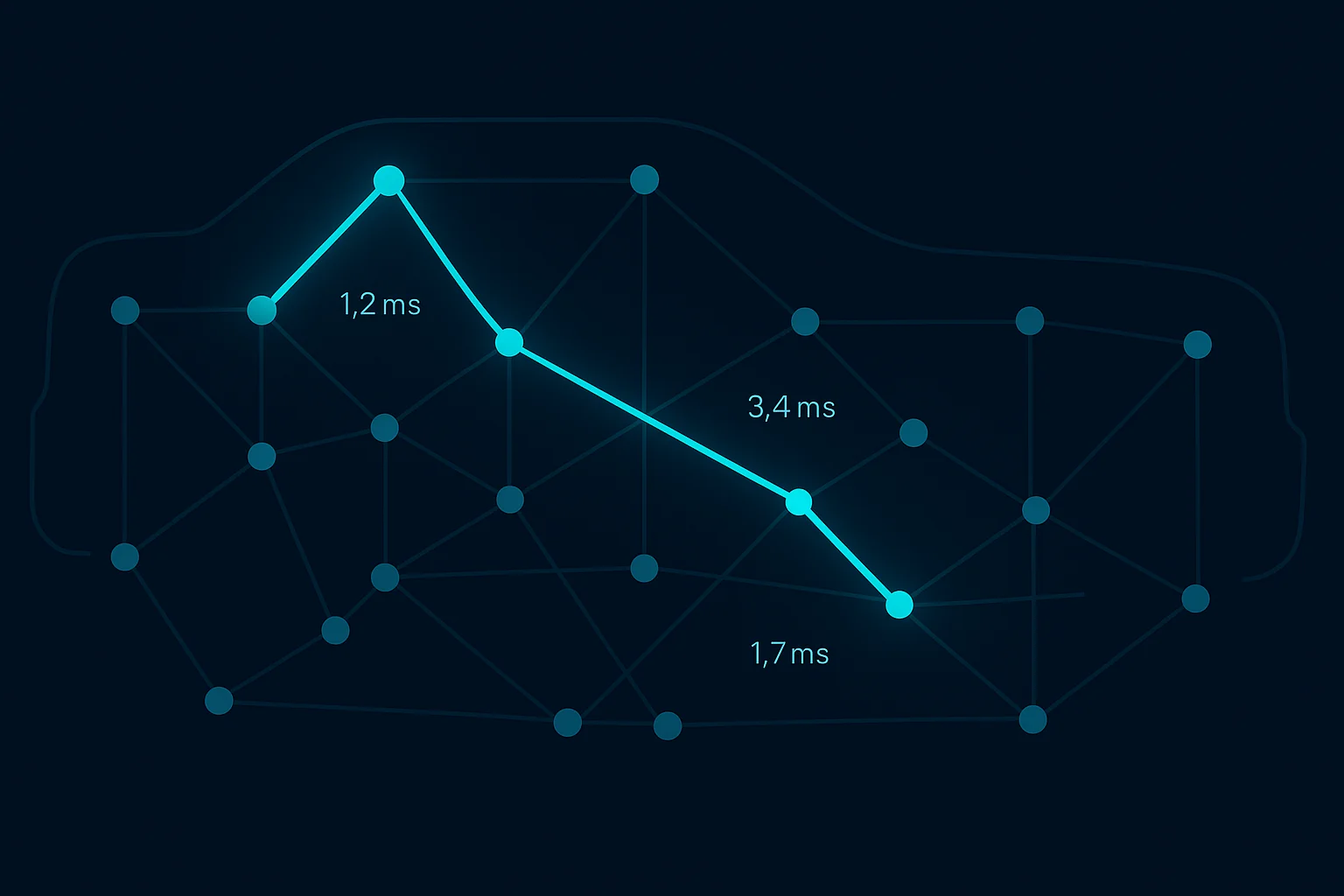
The bench exports topology graphs (ECUs = nodes, bus connections = edges) and measurement-based latency profiles to train Graph Neural Networks.
The models learn:
- Latency Prediction: Forecasting end-to-end latencies for new E/E architectures
- Bottleneck Detection: Identification of critical paths, bottlenecks, and QoS issues
- Software Placement: Automatic assignment of modules to ECU, core, or accelerator
- Architecture Evolution: Evaluation of migration paths – domain → zone → central
Graphs That Understand Vehicles
Graph Neural Networks operate directly on the vehicle's E/E topology: ECUs as nodes, bus connections as edges, latency profiles as weights. This produces models that evaluate architectures before hardware is installed.
"The network understands the network – GNNs detect patterns that remain invisible manually."

03 – AI-Based Optimization of Vehicle Architecture
The AI models deliver concrete optimization proposals that are implemented in the SDV Platform:
- Network Paths & Routing: Minimizing latency and jitter while distributing load across parallel paths
- Software Placement: Automatic selection of the optimal hardware platform – x86, ARM, RISC-V, GPU, FPGA – based on latency and energy profiles
- TSN Profiles: Optimization of priorities, VLAN settings, and TAS scheduling for different traffic classes
- Failover Strategies: Detection of critical nodes and proactive switchover to redundant paths – before the fault occurs
Intelligent Routing in Real Time
AI models analyze the vehicle topology and identify optimal data paths considering latency, utilization, and redundancy. Suboptimal routes are automatically detected and replaced with better alternatives.
"The AI doesn't optimize blindly – it validates every recommendation on the physical bench."
04 – Realistic Assurance Under Hardware Conditions
All AI proposals undergo full hardware validation on the SDVA Test Bench before release:
- Physical Switching: Topology changes via the switching matrix – real signal paths, not virtually routed
- End-to-End Latency: Measurement of actual delay under real conditions
- Shadow Mode Comparison: AI proposals run in parallel with production logic – risk-free assurance
- FPGA Timestamps: Hardware-based time measurement eliminates software overhead – µs precision
Why AI Is Becoming Indispensable in the SDV
- Data-Driven Instead of Static: Modern E/E topologies with hundreds of nodes and thousands of parameters are too complex for manual optimization – AI recognizes patterns that humans overlook
- Faster Development: Reproducible bench tests and shadow mode validation accelerate the path from prototype to production readiness
- Performance & Efficiency: Smart routing, intelligent software placement, and automatic hardware selection reduce latency and energy consumption
- Prerequisite for OTA: Dynamic homologation requires automated risk assessment, dependency analysis, and performance prediction – exactly what the AI pipeline delivers
In Brief
AI makes the SDV faster, safer, and more efficient – from topology to function logic. The platform combines:
- Real-World Data: High-resolution bench measurements instead of synthetic simulations
- Learning Models: GNNs that predict latencies and evaluate architectures
- Automated Decisions: Routing, placement, and TSN configuration driven by AI
- Hardware Validation: Every AI proposal is physically verified on the bench
The result is an intelligent SDV platform that continuously improves.
More Technology Pages: SDV Platform · WebAssembly · Test Platform